Ask a tropical diver about the Mediterranean and you might get a shrug: no coral walls, no clouds of neon fish. Ask someone who actually dives here and you will hear something quite different. This is a sea for slow, curious eyes. Along the coast between Side, Antalya and Alanya, rocky reefs, sandy channels and light-filled shallows hide a cast of characters that reward divers who take their time. Here are six of them — and the simple etiquette that keeps every encounter good for you and for the animal.
An honest word before we start
No responsible dive team guarantees animal sightings, and we never will. The sea is not an aquarium: what you meet depends on the site, the conditions and a little luck. What we can say is that our instructors dive these waters day in, day out and know where each species likes to hold territory. And because every one of our full-day boat trips includes two guided dives — beginners start shallow at 5–8 metres and go to about 13 metres on the second dive, while certified divers dive the real profiles on the same boats, around 30 metres on standard certified dives and down to 60 metres on the deep sites if they are suitably qualified — you explore two different zones of the reef in one day, which quietly doubles your chances.
Six Mediterranean characters worth knowing
Sea bream
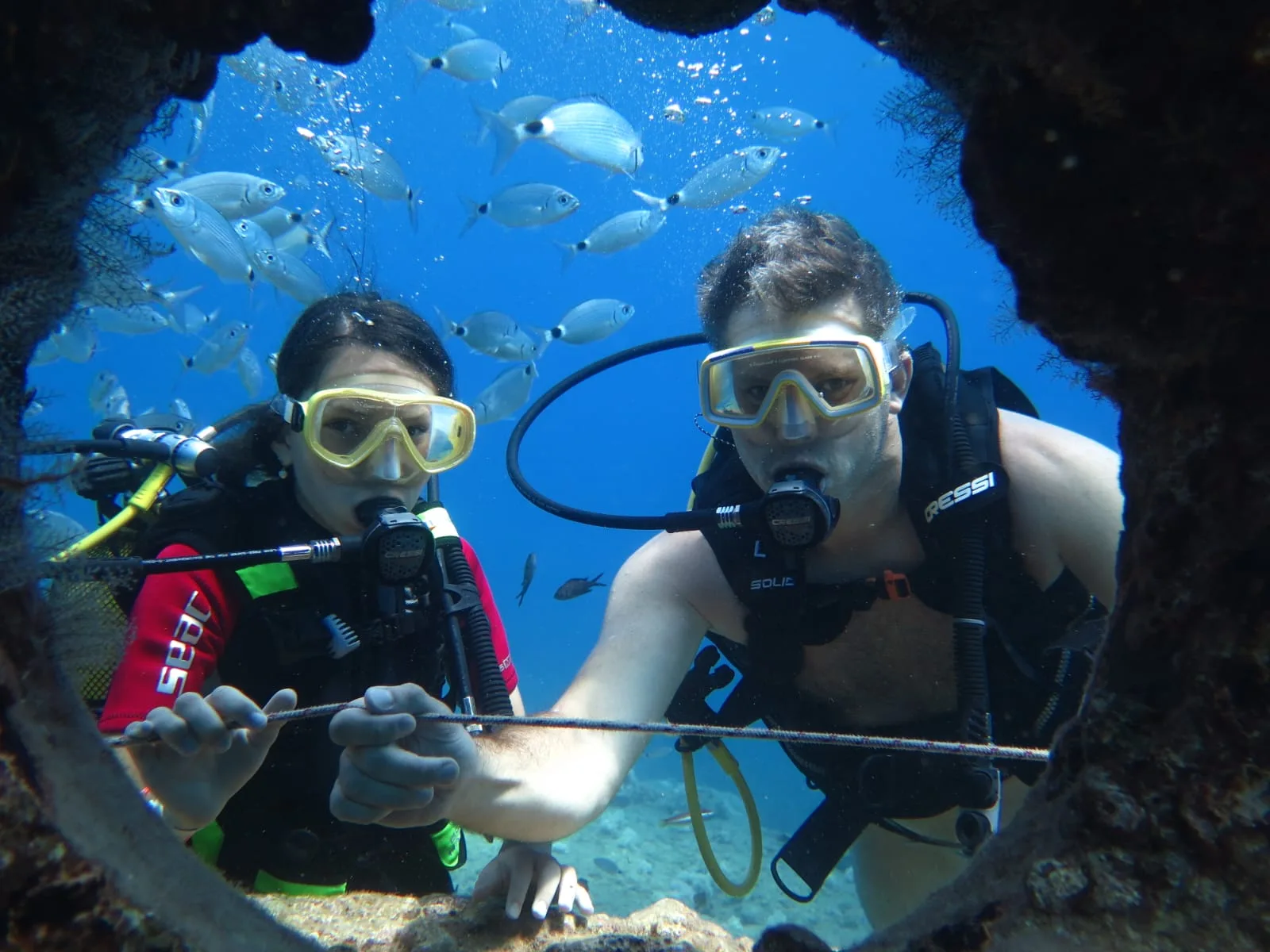
The silver welcoming committee. Several bream species patrol the border between sand and rock in loose, flickering schools, and they are famously curious about divers. Look for the dark saddle marking near the tail on some of them. On our Side Underwater Museum trip, hand-feeding fish under your instructor's guidance is part of the experience — one of the rare moments when the fish come to you rather than the other way round.
Damselfish
Those clouds of small dark fish hovering a metre above the rocks are damselfish. The adults look almost black in the water; the juveniles glow an astonishing electric blue. They are fiercely territorial for their size — watch one dart out to chase off a fish three times bigger and you will never call them boring again.
Wrasse
If something small, colourful and busy zips past your mask, it is probably a wrasse. Ornate and rainbow wrasse are constant companions on Mediterranean reefs, always working, always inspecting. A detail worth knowing: many wrasse species change sex during their lives, with dominant females transforming into brilliantly coloured males.
Grouper
The dusky grouper is the personality of the rocky reef: big lips, heavy body and a slow, appraising stare. Groupers love overhangs, boulders and holes, and older individuals can become surprisingly relaxed around calm divers. The rule is simple — stop, hover, and let the fish decide how close it wants to come. Chase it and the encounter is over in a second.
Octopus
Finding an octopus is the classic guide's party trick, because most divers swim straight past them. Look for a small pile of empty shells outside a hole — the leftovers of past meals — then find the eye watching you from the shadows. If it feels safe, an octopus may shift colour and texture right in front of you, one of the finest sights in this sea. Never pull one from its den; simply hover and let it perform.
Moray eel
A moray peering from a crevice, mouth slowly opening and closing, looks menacing — but that motion is just how it pumps water over its gills to breathe. Morays are not aggressive toward divers who keep a respectful distance. They are, however, all muscle and teeth, and they will defend their crevice if fingers appear in it. Which brings us to the golden rule.
The no-touch rule
Everything on a Mediterranean reef lives better without our hands on it. Fish carry a protective mucus layer that touching damages. Octopuses stress easily. Morays bite when cornered — and it is always the diver's fault. So the etiquette we repeat at every briefing is short:
- Touch nothing, take nothing, chase nothing. Photographs and memories only.
- Control your buoyancy. Staying off the bottom protects both the reef and your knees — your instructor helps you with this on every dive.
- Keep your hands close to your body near holes and crevices.
- Watch your fins over sand — one careless kick can wrap the whole group in a cloud of silt.
How to meet more animals on one dive
Slow is the whole secret. Divers who race cover more ground and see less. Breathe calmly, move at half your normal pace, and look small: blennies in finger-width holes, hermit crabs commuting across the sand, a wrasse inspecting a bigger fish. Stay just behind your guide's shoulder — instructors spot animals for a living, and in a small guided group nobody misses the show.
Come and meet them
You do not need a licence or any experience. Every trip includes a full safety briefing, all equipment, fresh lunch on board, free hotel transfer and insurance, and beginners are guided from their first breath underwater. Read more about Mediterranean marine life, start with a beginner-friendly dive, or browse all our boat trips. Reservation is free online and you pay on the day.