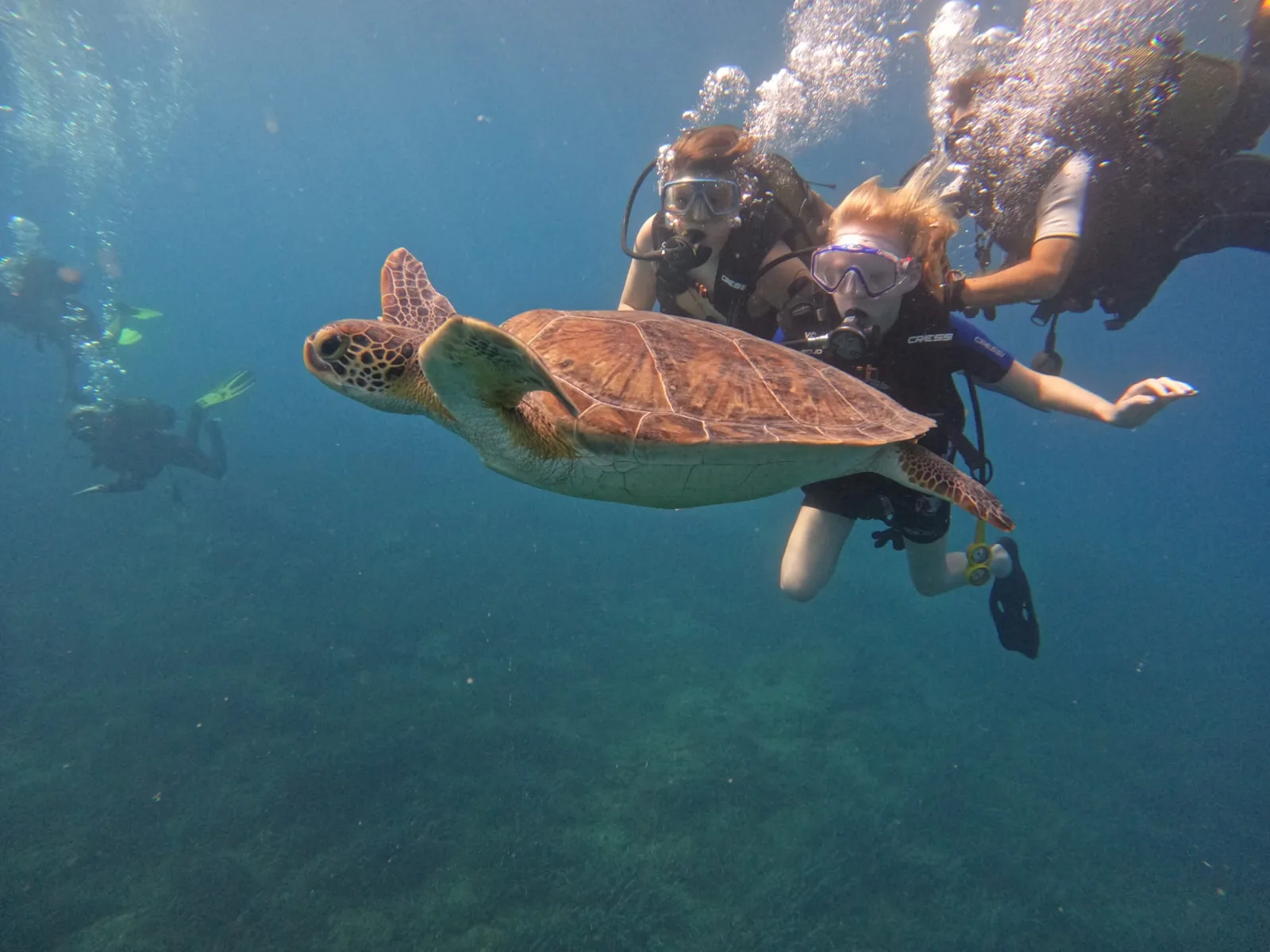
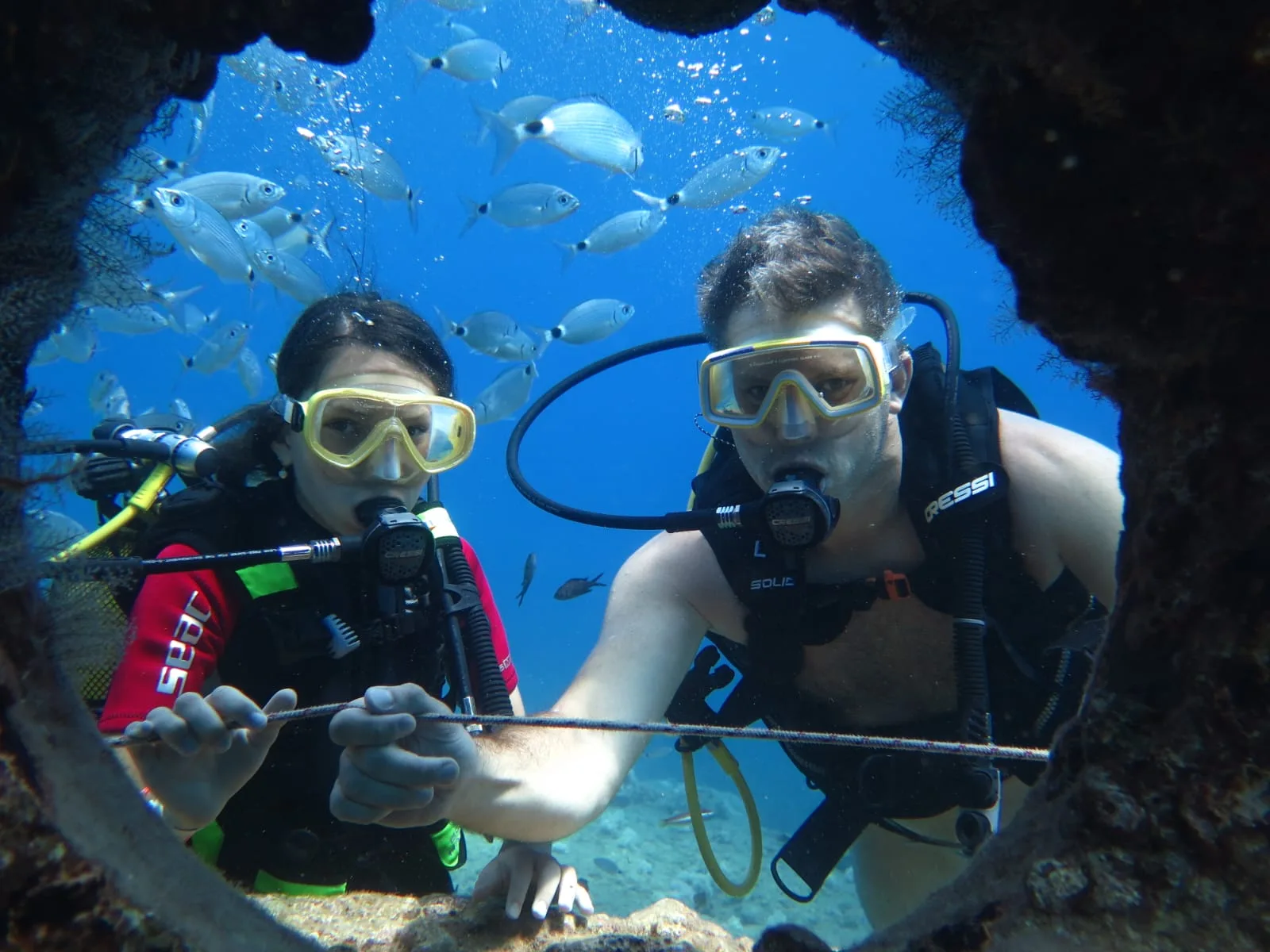
Beginners use exactly the same equipment as experienced divers, and on our trips every piece of it is included: mask, fins, wetsuit, buoyancy jacket, tank, regulator set and weights. You bring a swimsuit, a towel and sun protection. Nothing needs to be bought, hired elsewhere or researched in advance, and the crew sizes and fits each item for you on board before the briefing.
The kit we hand you, piece by piece
Mask
A dive mask covers your eyes and nose. It seals against your skin so you can see clearly underwater, and it includes the nose because you need to pinch it to equalise your ears and to blow water out if any gets in. Fit matters more than anything else: the right mask sits on your face without a strap and stays there when you inhale gently through the nose. The crew checks that on the boat.
Fins
Fins turn a small leg movement into forward travel, which is why divers keep their arms still. Open-heel fins with adjustable straps are worn over neoprene boots, so sizing is quick and forgiving. Slow kicks from the hip, not the knee, are all a beginner ever needs.
Wetsuit
A wetsuit keeps you warm by trapping a thin layer of water against your skin, which your body then heats. It also protects you from sun on the boat and from scrapes on rock. Antalya's sea runs at roughly 17 degrees in winter and rises to about 28 to 29 degrees in late summer, so the thickness we hand you depends on the time of year. Being slightly warm on deck is normal, and it pays off underwater.
BCD, the buoyancy jacket
The BCD is the jacket that holds your tank and lets you fine-tune whether you float, sink or hover. You inflate or deflate it with a button, and once weighting is correct you barely touch it. On a discovery dive the instructor manages your buoyancy for you, often with a hand on the jacket, so this is one less thing to think about.
Tank
The tank on your back holds compressed air, not oxygen, which is a common misunderstanding. It is heavy on land and effectively weightless in the water. It is why we walk you down to the ladder rather than asking you to carry it around the deck.
Regulator set
This is the part that makes diving possible. The first stage attaches to the tank and reduces the pressure; the second stage is the mouthpiece you breathe from, delivering air on demand every time you inhale. The set also includes an alternate air source, a second mouthpiece on a longer hose that can be handed to another diver, a gauge showing how much air is left, and a hose feeding the jacket. The instructor checks all of it before you get in, and again in the water.
Weights
A wetsuit floats, so a small amount of lead lets you descend calmly and hold your depth. More is not better. Correct weighting means floating at eye level with an empty jacket and a normal breath, then sinking gently as you exhale, and the instructor sets it for you.
Why you should not buy anything for a first dive
Every piece above is included in the trip price, from 43 euro, along with two guided dives, free two-way hotel transfer, lunch on board, insurance and a full safety briefing. Buying kit before you know whether you enjoy diving is the wrong order. Equipment is also personal: mask fit in particular is something you learn by trying several, and after a dive or two you will know what suits your face. Our diving equipment page covers what we carry.
If you do decide to bring something of your own, a mask you already know fits is the one item genuinely worth carrying. Everything else is bulky, needs servicing and gains you nothing on a holiday dive.
What to bring instead
- Swimsuit, worn under your clothes so you are ready when the boat leaves.
- Towel and a change of clothes, because sea air is cooler on the way back.
- Sun protection and a hat, for deck time between the two dives.
- Any prescription glasses information if you need it, and simply tell us so we can help.
- Your certification card and logbook if you are already a certified diver. We sign logbooks.
The full list is in our guide on what to bring scuba diving.
How the kit is fitted on the day
After the morning hotel pickup and the boat ride, the crew sizes wetsuits, boots and fins, then assembles each set of gear. You are shown how to put the jacket on, where the inflate and deflate buttons are, how to find your regulator and how the gauge reads. Nothing is rushed and nothing is assumed. Then comes the full safety briefing, and only after that does anyone enter the water. Because a discovery dive is instructor-led, your job is to breathe while the crew handles the technical side.
Try it with everything included
The Kemer diving trip at 43 euro takes beginners to the clearest water on this coast, with reef fish and octopus often spotted, and all standard equipment supplied. See every option on our prices page. Reserve free online, pay on the day in cash or by card, and cancel free up to 24 hours before. A thermal inner suit (diving undergarment) or any extra neoprene layer is not included in the price and is available as an optional extra on request.