The Short Answer
If you want to breathe underwater once or twice on this holiday, you need a discover (try) dive — no course, no exams, no paperwork beyond a health form, and you are in the sea the same morning with an instructor within arm's reach. If you want to keep diving for years, in other countries, without an instructor holding onto you, you need a certification — a proper multi-day course with theory, confined-water skills and open-water dives, ending in a card that does not expire.
Our five daily boat trips are guided dives, not courses: perfect for the first group. For the second group we run CMAS courses on request — message us with your dates and we will build the schedule around them.
What a Discover Dive Actually Is
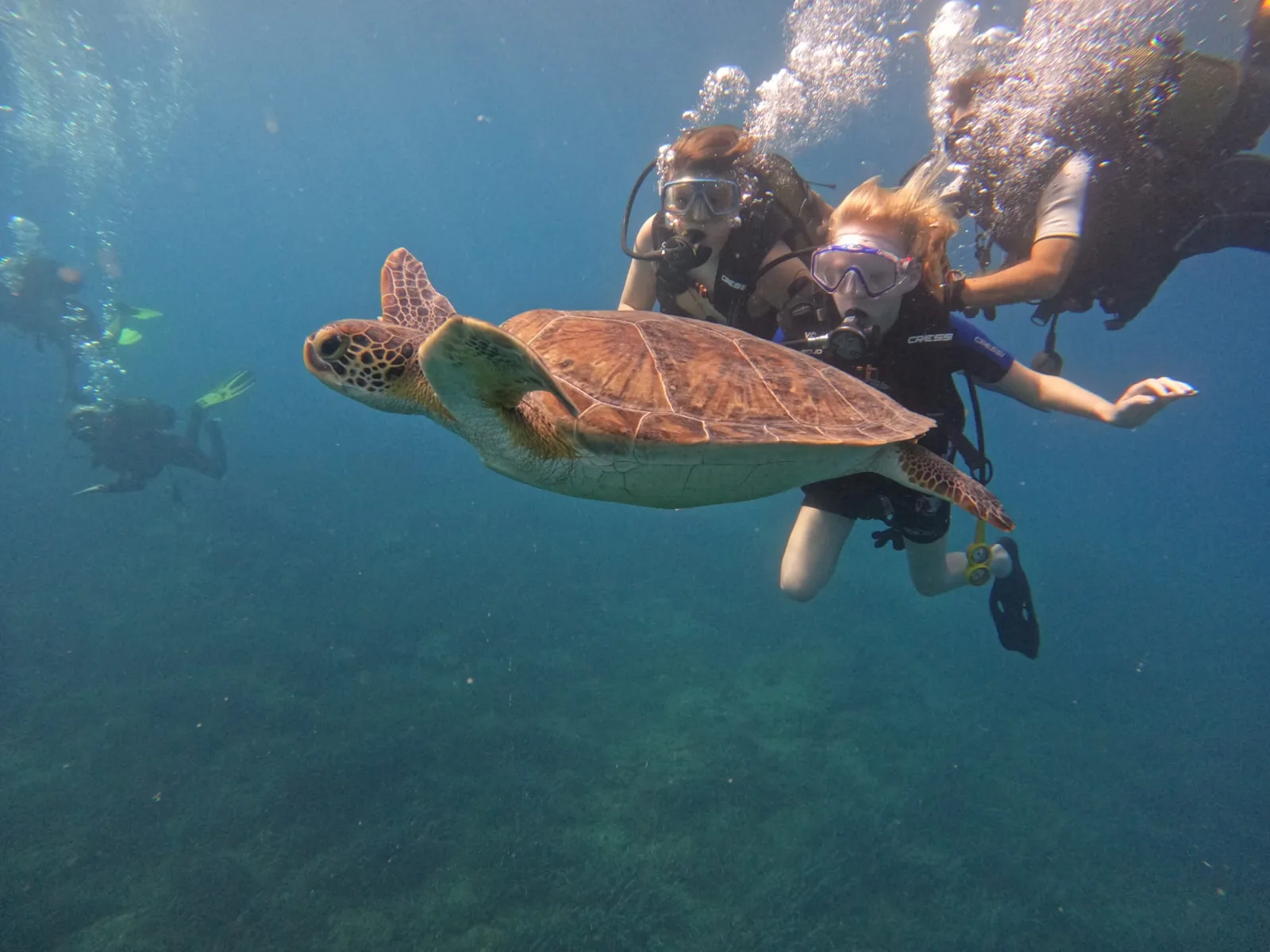
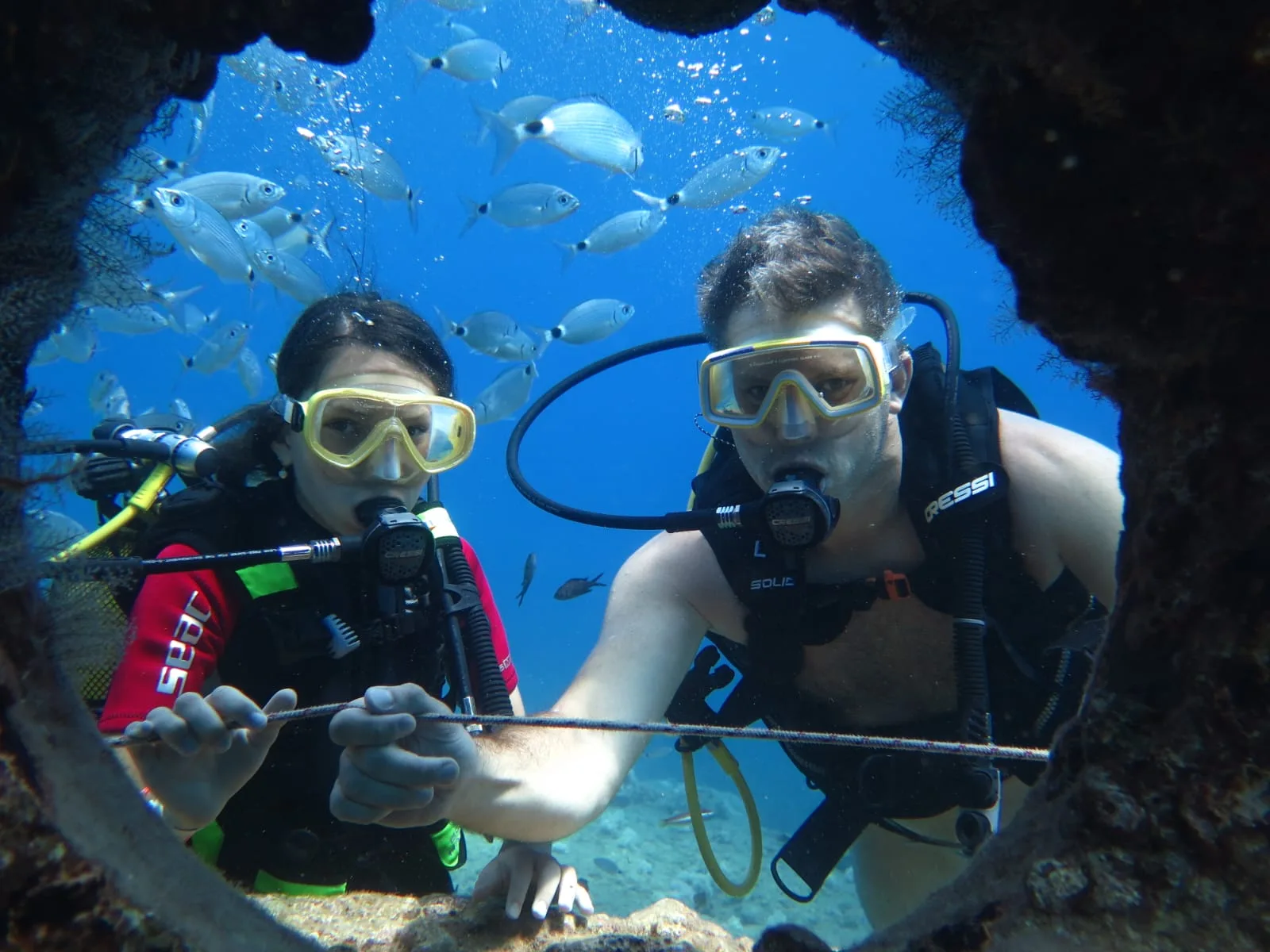
On a discover scuba day you join the boat as a complete beginner. You get a full safety briefing, all the equipment (tank, regulator, BCD, wetsuit, mask, fins and weights), and two guided dives with a maximum of 3–4 divers per instructor. The morning dive stays shallow — roughly 5–8 metres, where the light is bright and the fish are busy. The second dive goes deeper, to about 13 metres maximum, once you already know how your own breathing feels.
You are never sent off alone. The instructor stays beside you, controls the depth, and can add air to your jacket or let it out for you. There is no theory to memorise and no swimming test — plenty of guests who describe themselves as weak swimmers do this every week. Read our first-time guide if you want the full picture of the day.
What a Certification Actually Is
An entry-level certification is a real qualification, not a souvenir. It has three parts: theory (pressure, equalisation, safety rules, no-fly guidance, tables or computers), confined-water skills (clearing your mask, recovering your regulator, controlling your buoyancy, sharing air with a buddy) and open-water dives where you repeat those skills in the sea.
What you get in return is independence. A certified diver books a two-dive boat trip anywhere in the world, dives with a buddy rather than clipped to an instructor, and here on the Antalya coast joins the standard certified profile of around 30 metres. With the right further qualification the deep sites open up — up to 60 metres on the ones that go that far, including the Paris II wreck at 21–31 m and the DO-28 aircraft at 19.5–23.3 m. Those are certified dives. They are never, under any circumstances, a discovery dive.
Time, Depth and Cost — The Honest Comparison
Time. A discover dive costs you one day. A certification realistically costs several consecutive days of your holiday, which is why people book it at the start of a trip rather than the end.
Depth. Discovery: 5–8 m, then about 13 m maximum. Certified: around 30 m as standard, up to 60 m with the appropriate deep qualification.
Cost. Our guided day trips are €43–€50 for the whole day, and every one includes two dives, all standard equipment, free two-way hotel transfer, fresh lunch on board, passenger and diving insurance. The Side Underwater Museum trip is €45 for about 7 hours; Kumköy, Kemer and Alanya are €43, Antalya €50. Two dives for €45 works out at roughly €22.50 per dive with everything included — which is why many visitors simply do two or three trip days instead of a course. A course is a bigger investment of both money and days; we quote it individually because it depends on the dates and the group, so please ask us. A thermal inner suit (diving undergarment) or any extra neoprene layer is not included in the price and is available as an optional extra on request.
So Which One Should You Book?
- Choose a discover dive if you have one or two free days, you want to see the Underwater Museum or a reef, and you are curious rather than committed.
- Choose a certification if you already know you loved it, you dive on future holidays, or you want to reach the wrecks and caves that beginners cannot.
- Do both — the sensible order. Try a guided day first. If you surface grinning, tell the instructor on the boat and we will talk about the course.
Book Your Day
Reserving is free: pick a date on any of our dive trips, and you pay on the day, in cash or by card. Cancellation is free up to 24 hours before. Hotel pickup is in the morning and the exact time is confirmed the evening before, once the boat schedule is set. If you are weighing up a course, send us your holiday dates and we will tell you honestly whether they fit.