If you searched for a PADI course in Side, here is the straight answer first: Side Diving is a dive house with PADI-certified instructors, and the certification courses we organise ourselves are CMAS courses — taught from our own boat, arranged on request. On this page we explain both systems exactly as they work, so you can choose the right starting point.
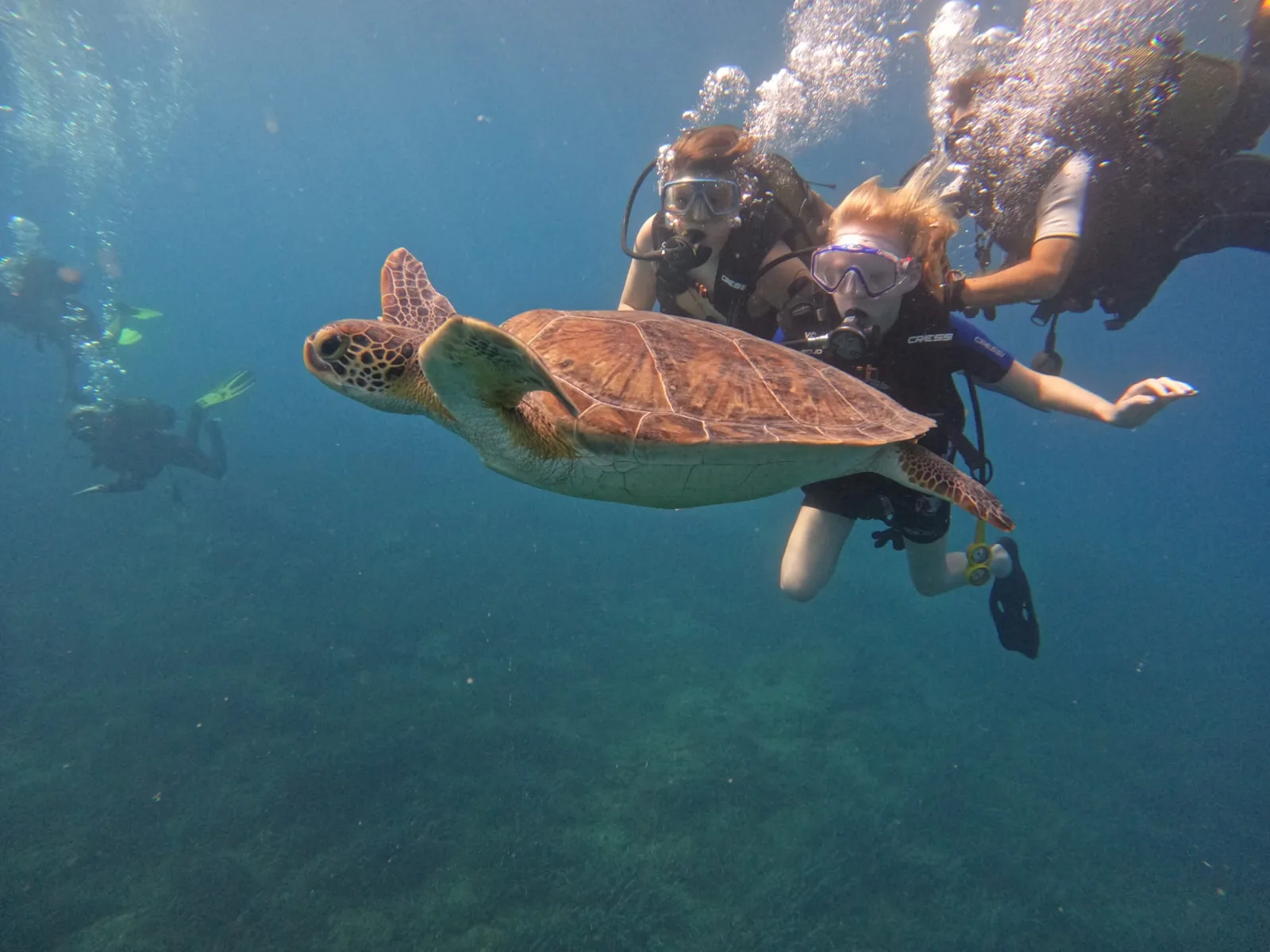
Most guests do not start with a course at all. They start with a try-dive: all five of our boat trips are built for complete beginners — two guided dives with no licence required — a gentle first dive at 5–8 metres and a second to about 13 metres, which is the beginner ceiling — with no more than 3–4 divers per instructor.
One thing you will not find here is a published course price. Courses run over multiple days and are planned individually, so prices and schedules are quoted on request — the honest reasons why are explained below.
From First Breath to Certified: How the Pathway Works
Diving certification everywhere in the world follows the same three honest steps, whichever logo ends up on your card. Step one is a try-dive: a supervised experience dive with no theory exam and no licence, where an instructor controls your buoyancy and depth while you simply breathe and look around. That is exactly what our five boat trips are — every guest makes two guided dives, a gentle morning dive at 5–8 metres for 15–25 minutes and an afternoon dive to about 13 metres, the ceiling for divers without a licence, always with no more than 3–4 divers per instructor.
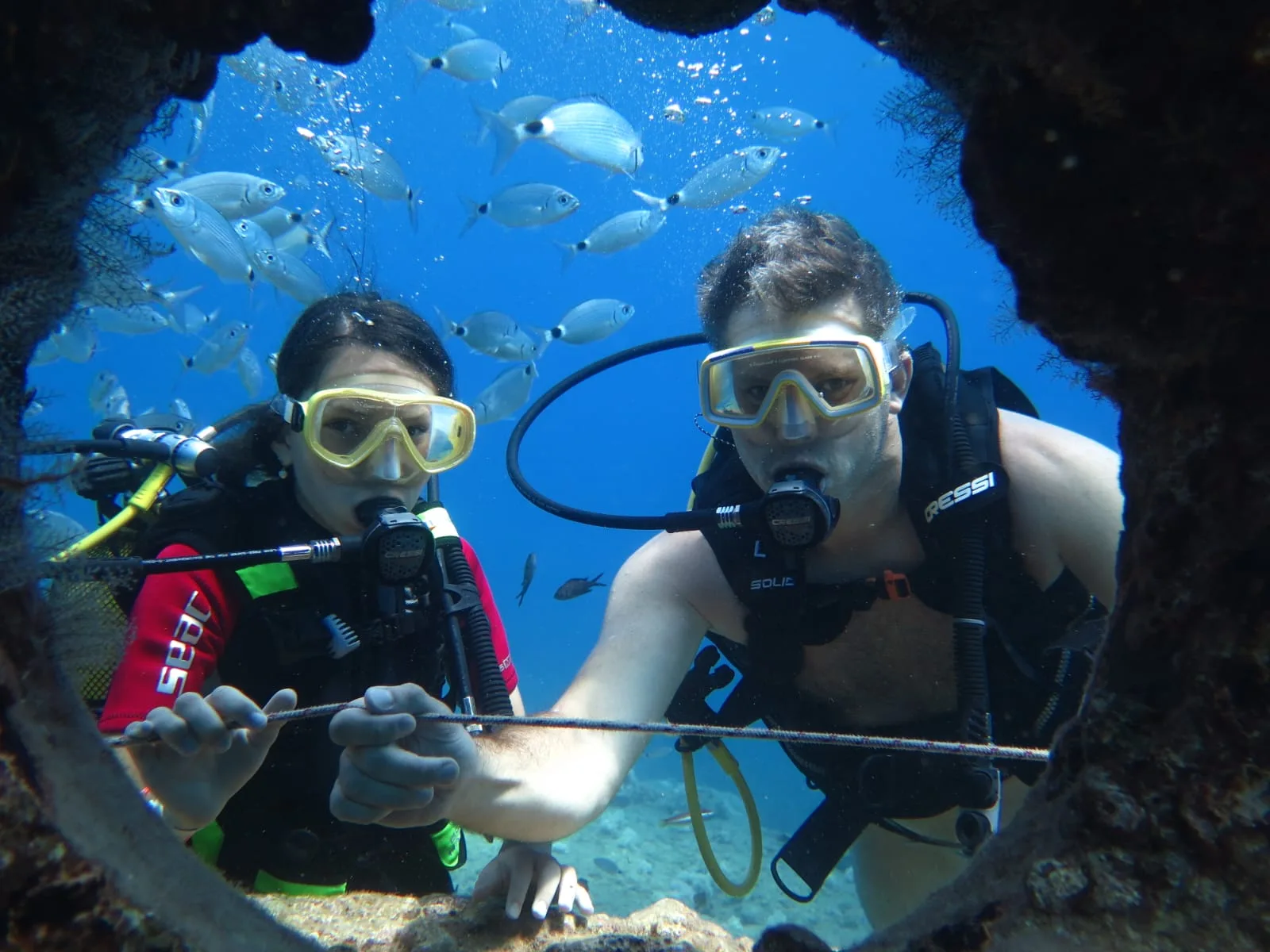
Step two is entry-level certification: PADI calls it Open Water Diver, CMAS calls it One Star Diver. Both combine theory, shallow-water skill practice and several open-water training dives, and both qualify you to dive with a buddy, without an instructor, to roughly 18–20 metres. The two cards are recognised by dive centres worldwide and treated as equivalent, so neither choice locks you out of anything. Step three is the advanced level — PADI Advanced Open Water or CMAS Two Star — which adds deeper dives, underwater navigation and first speciality experience such as wreck or night diving.
The practical point most first-timers miss: a real certification course cannot be squeezed into one day. Between theory, skills and the required open-water dives, students typically need several days on and in the water, which is why a course is best planned around your holiday dates rather than bolted onto the end of them. If you are not sure which step you are at, start at the beginning: book a try-dive, feel what twelve metres is like, and talk to your instructor on the deck afterwards. That conversation is free and worth more than any brochure.
CMAS Courses from Our Boat — Arranged on Request
Here is the honest part most search results will not tell you: the certification courses Side Diving organises itself are CMAS courses — arranged on request and taught from our own boat, with PADI-certified instructors in the team. You will not find a published course price on this page, and that is deliberate, not evasive. A course is not a seat on a boat; it is several days of an instructor's time. The right price depends on your starting level, how many training days you need, whether you come alone or as a family of three, and which certification you are working toward. Quoting one number for all of that would mean inventing one.
Instead, tell us your dates, your experience and your goal through our contact page or on WhatsApp, and you will get a personal plan with a clear, fixed price before you commit to anything. What we can promise about the course experience itself: you learn on the same boat and the same coastline as our daily trips, in the small-group style this house runs on — never an anonymous classroom crowd. How the course days are structured — pool-style shallow practice, open-water dives and theory — is agreed with you when we plan the course; message us and we will map out a schedule that fits your holiday.
If you already hold a certification from any agency, bring your card and logbook — our instructors sign logbooks on every trip, and a few logged holiday dives are the cheapest way to keep your skills current between courses. And if, after your try-dive, you decide certification is not for you this year, that is a perfectly good outcome too. The sea will still be here next season.
Not Ready for a Course? Start with a Try-Dive
Every certified diver on earth started with one supervised breath underwater, and on this coast that first breath is easy to arrange. Our five full-day boat trips are all built for complete beginners — no licence, no experience, no swimming-pool detour. The flagship is the Side Underwater Museum trip (€45, about 7 hours): a sunken sculpture park of around 110 statues resting at about 12 metres, where you drift between the figures with your instructor and hand-feed the fish that have made them home.
From Kumköy we run a shorter 6-hour day (€43); from Kemer — known for the clearest water on this coastline — an 8-hour day (€43) over reefs, rock formations and octopus territory; Antalya (€50, 8 hours) adds reefs, caves and shoals of fish; and Alanya (€43, 8 hours) dives the caves and rocky reefs in the waters off Cleopatra Beach. Whichever you choose, the format is identical: two guided dives (morning 5–8 m, afternoon about 13 m for beginners), all equipment, a fresh lunch cooked on board, passenger and diving insurance, a full safety briefing, and free hotel transfer both ways — morning pickup, with the exact time confirmed the evening before. Friends or family who prefer to stay dry join as boat guests at a reduced rate, so nobody is left behind at the hotel.
Booking works the way a first-timer wants it to: reserve free online, pay on the day, cancel free of charge up to 24 hours ahead. Try-dives are possible from around age 10, and if you have younger children, ask us — gentle kids' bubble programmes exist and we will tell you honestly what is possible. Compare all five days on the tours page or check the full price list before you decide.
What Certification Unlocks on This Coast
Why bother with a certification card at all? On this particular coastline the answer is concrete. The try-dive format has a hard ceiling of about 13 metres for divers without a licence — that rule keeps beginners safe, and it also means the most storied sites here stay out of reach until you are certified. Once you hold a card the ceiling moves a long way: certified divers dive around 30 metres on standard certified dives and down to 60 metres on the deep sites when they are qualified for them. The MS Paris II at Kemer is a roughly 70-metre French freighter from the First World War era, lying between 21 and 31 metres: squarely certified-diver territory. Not far away sleeps the DO-28, a Dornier aircraft from 1967, at 19.5–23.3 metres. Near Alanya's harbour an ancient amphora field scatters its jars across the seabed — octopus, grouper and moray are often seen there — and Alanya's underwater caves, tied to the story of the Mediterranean monk seal, reward divers trained for overhead environments.
Even the reef sites grow with you. Three Islands (Üç Adalar) off Kemer layers reefs and caves, with the occasional dolphin passing through, and the Lighthouse reef runs from 3 to 18 metres with a 9-metre swim-through tunnel. To be completely clear about who dives them: these deeper sites and the wrecks are for certified divers only and never for try-divers — but for a certified diver they are ordinary dives here, comfortably inside the roughly 30 metres of a standard certified dive. Which site you actually dive depends on your qualification level, the conditions and the day's plan, so send us your certification level and logbook history and we will plan honestly around them.
Two health rules apply to everyone, students and try-divers alike: diving is not possible during pregnancy or with serious asthma, heart or respiratory conditions, and you must not fly within 24 hours of your last dive — so put your dive days early in the holiday, not the day before departure. A certification card is not a formality; on this coast it is the key to a genuinely different sea.