Short answer: you will learn roughly eight hand signals before your first dive, and you will practise them on deck until they are automatic. The core set is OK, up, down, stop, problem, low on air, out of air and look-at-this. They are practised dry, repeated in shallow water, and used constantly during the dive — your instructor will ask "OK?" every few minutes and expects an answer.
Why Divers Use Hands Instead of Words
Two things make speech useless underwater. The first is obvious: a regulator sits in your mouth and stays there. The second is that sound behaves strangely underwater — it travels roughly four times faster than in air, and your ears cannot tell where it came from, so even a shout gives no direction. Hands solve both problems at once. A signal is silent, instant, unmistakable at reading distance, and it works equally well for a Turkish instructor and a German, Polish or Russian guest, which matters on a boat where five languages get spoken before breakfast.
Hand signals are also the reason a dive stays calm. Almost every problem underwater is small at second one and larger at second sixty. A signal lets you hand it over in the first second, and with a maximum of 3–4 divers per instructor on our trips, there is always someone looking at you.
The Signals You Will Actually Use
OK — thumb and forefinger in a circle
The most used signal, and the one most beginners get wrong. It is both a question and an answer: if your instructor makes it, you must reply, and the reply is the same circle. A thumbs-up is not "OK" in diving — it means "let's go up". Nodding does not count either; the mask hides too much.
Up — thumb pointing up
Means "end the dive and ascend". Any diver may give it, at any moment, for any reason, and the answer is always yes. There is no negotiation and nobody is made to feel awkward — a diver who wants to go up, goes up.
Down — thumb pointing down
"Let's descend." On a discovery dive your instructor sets the pace, holds on to you, and takes you down slowly while you equalise your ears step by step.
Stop — flat palm facing you
Everyone stops and holds position. Used before a descent, at a line, or when the group needs to regroup.
Problem / not OK — flat hand rocking side to side
Followed by pointing at what is wrong: ear, mask, cold, an arm. This is not an emergency signal, it is a "something is not right" signal, and it is the one we most want beginners to use freely.
Low on air — closed fist against the chest
Say it early. Your instructor also checks your gauge, but a signal from you is faster. Read what actually happens in our guide to running low on air.
Out of air — flat hand moved across the throat
The signal that brings the instructor's alternate mouthpiece straight to you, followed by a slow ascent together. It is taught to every guest, and used essentially never.
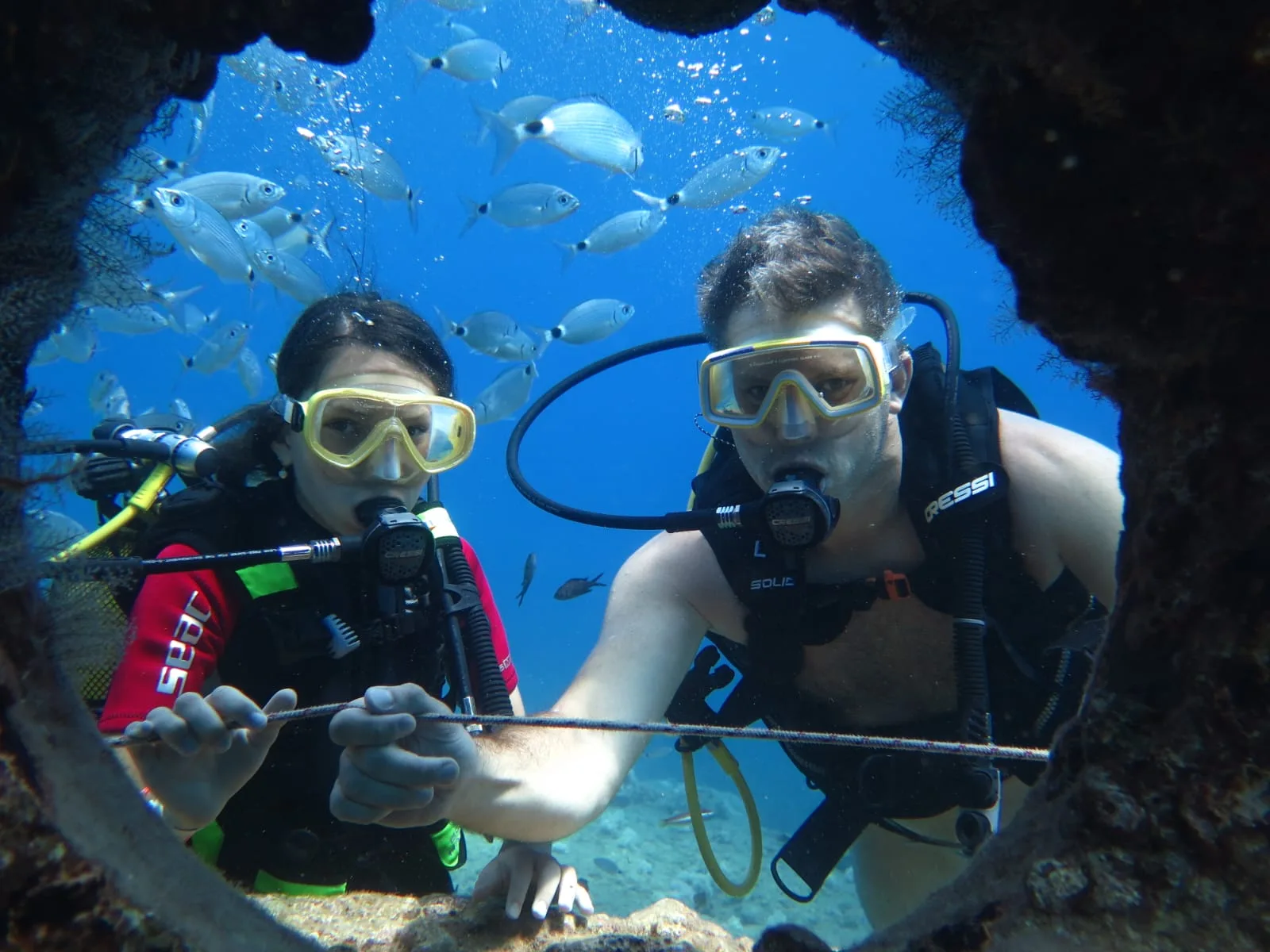
Look / watch me — two fingers pointing to the eyes, then at the thing
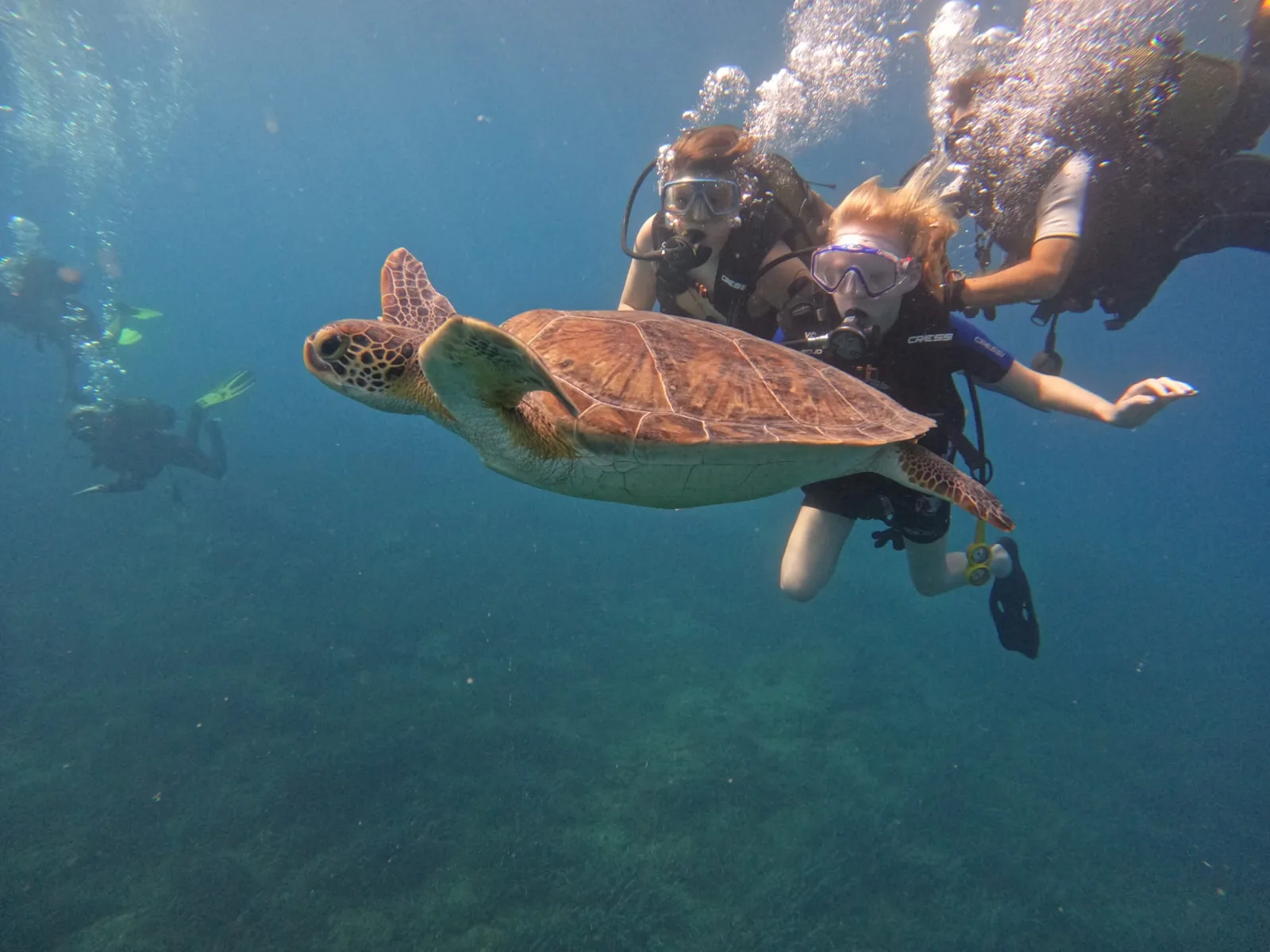
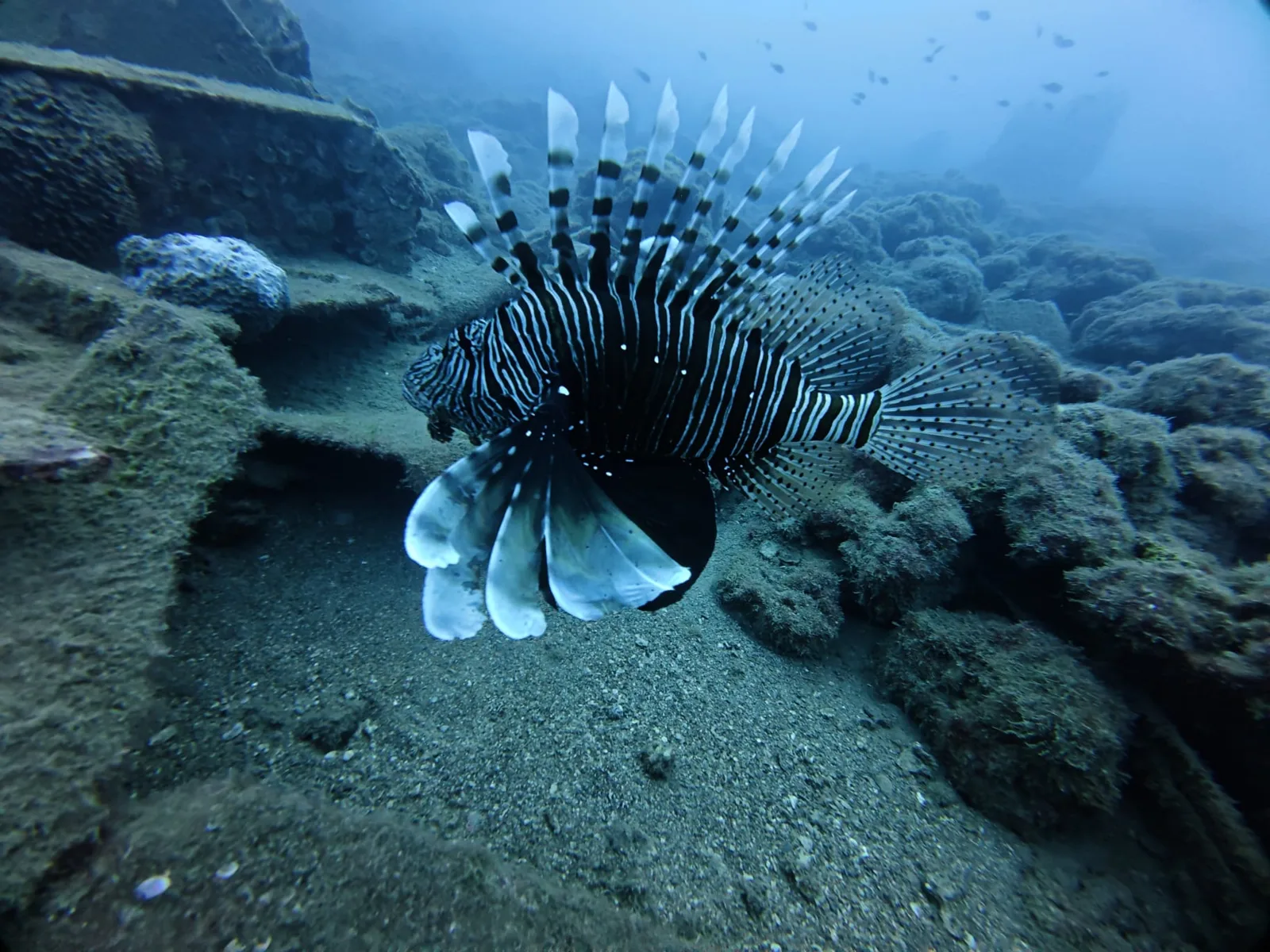
The most enjoyable one. This is how your instructor shows you an octopus tucked into a rock, a shoal turning above a reef or a face on one of the sculptures. More about what you may meet on our marine life page — sightings vary with conditions.
Two Extras Worth Knowing
- Equalise: fingers pinched to the nose. It means "pause, I need to clear my ears" — one of the most common signals of any first dive.
- Slow down / calm: palm down, patting the water gently. Usually paired with a reminder to breathe slowly, which fixes about half of all beginner discomfort by itself.
- Getting attention: a tap on your own tank or a wave in someone's field of view. Nobody grabs anybody.
How the Briefing Teaches Them
Nothing here is learned from a page. On the boat, before anyone puts on a wetsuit, your instructor demonstrates each signal, asks you to copy it, and checks that you answer the OK question rather than nodding. In the water the first minute is spent repeating them at a depth where you can stand comfortably. Then, throughout the dive, the loop keeps running: instructor asks, you answer, instructor moves on. That rhythm is exactly why the beginner programme sits at 5–8 metres on the morning dive and around 13 metres at most on the second — shallow enough to stay conversational.
Certified divers use the same core set plus number signals for tank pressure and a few site-specific gestures agreed in the briefing before certified diver dives.
Learn Them Where They Are Used
Ten minutes on deck and one dive is all it takes for these to stop feeling like a lesson. Our full-day trips run from €43 to €50 and include two guided dives, all standard equipment, free hotel transfer, lunch on board and insurance — from the Side Underwater Museum to Kemer. New to all of this? Start with the first-time diving guide, browse the dive trips, or ask us anything. Reserve free, pay on the day. A thermal inner suit (diving undergarment) or any extra neoprene layer is not included in the price and is available as an optional extra on request.