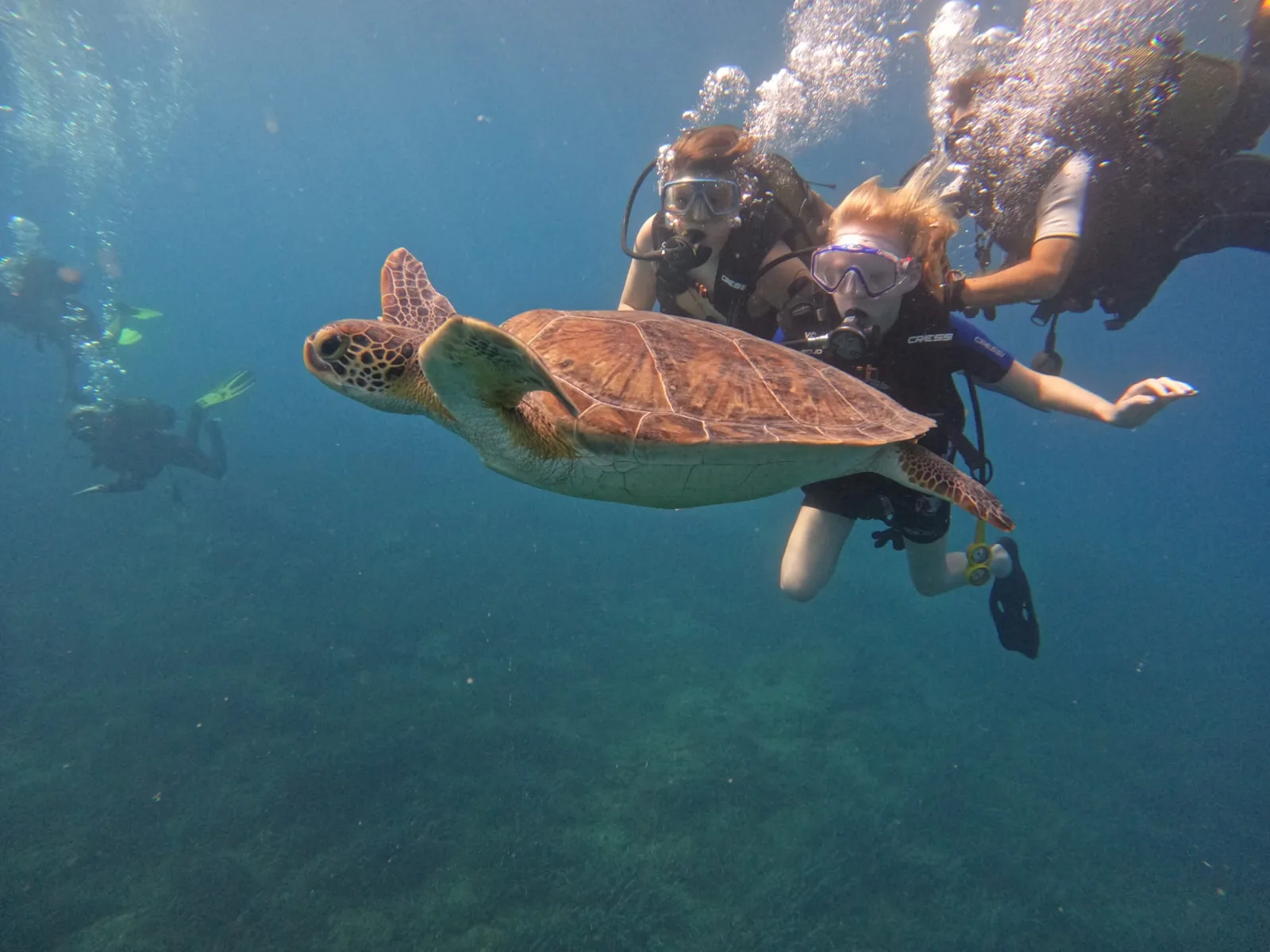
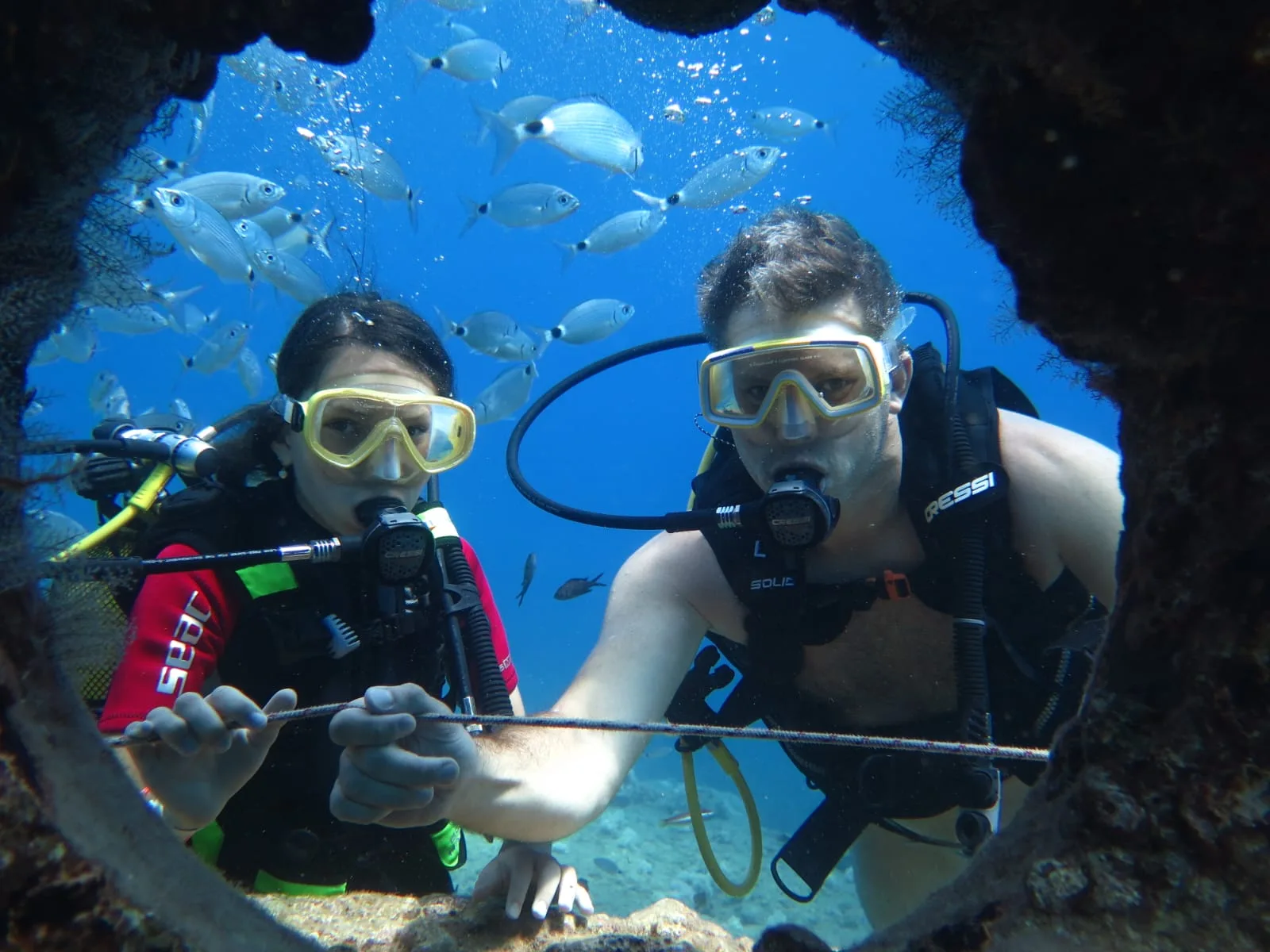
No. A beginner never dives alone, and never dives in a pair with another beginner either. On a first dive an instructor stays within arm's reach of you for the entire time you are underwater, usually with one hand on your harness or close enough to reach it in an instant. On our flagship Side Underwater Museum trip we keep three to four divers per instructor, and the boat crew stays on the surface watching the water the whole time.
Who is actually with you underwater
Picture the dive from above. On the surface there is the boat with the captain and crew, the ladder down, and someone whose job is simply to watch. In the water there is your instructor, and beside you the small group you came down with. Nobody swims off alone, nobody is asked to navigate, and nobody is handed a route to follow. The instructor decides where the group goes, how deep it goes and when it turns around.
Our instructors are PADI-certified and lead these dives every day of the season. They know the sites metre by metre, which means they are not exploring while looking after you. That familiarity is the quiet reason a guided beginner dive feels so unhurried: the guide already knows what is around the next rock.
Why three to four divers per instructor matters
Ratios are not a marketing detail, they are the difference between being supervised and being watched. With three or four beginners, an instructor can keep every person inside a single glance, see who is breathing fast, notice a mask filling with water before its owner does, and correct buoyancy with a fingertip on a shoulder strap. With a dozen people that stops being possible.
It also changes the feel of the dive. In a small group you get eye contact, hand signals answered immediately, and time. If you need a minute at four metres before going deeper, the group waits. Nobody is dragged along at somebody else's pace.
What the guide is actually doing down there
A good dive guide looks relaxed and is in fact working continuously. Through the whole dive the instructor is:
- Watching your breathing. Fast, shallow breathing is the first sign of tension, long before anyone would call it a problem, and it is fixed with a calm hand signal and a pause.
- Checking your air. The instructor asks for your gauge reading at intervals with a hand signal, and plans the turnaround on the person using air fastest, not the average.
- Managing your depth. Beginners drift down without noticing. The guide holds the group at five to eight metres on the first dive and around thirteen metres maximum on the second.
- Fixing small things. A leaking mask, a fin strap, a hose in the wrong place, a weight belt sliding. All of it is sorted underwater in seconds.
- Showing you the good bits. Pointing out an octopus in a crack, a shoal turning overhead, the face of a sculpture. Sightings vary with conditions, so a guide who knows the site is worth a great deal.
The buddy system, explained honestly
Diving has a rule that nobody dives alone. Certified divers pair up as buddies, check each other's kit before the giant stride, stay close together and share air if one runs low. It is a simple, robust system and it is the backbone of recreational diving worldwide.
For a beginner, the instructor is your buddy. You do not have to remember to check anyone or keep track of anyone. If you dive with a partner or a friend for the first time, you will be in the same small group, close enough to point at things together, but the professional responsibility sits with the instructor, not with either of you. That is the honest answer many people are quietly worried about: you are not being made responsible for someone you love on your very first dive.
What happens if something goes wrong
Almost nothing does, and the answer to almost everything is the same: signal, and go up slowly with the instructor. Every instructor carries a second regulator, the alternate air source, on a longer hose specifically so it can be handed to another diver. Every trip has a full safety briefing, passenger and diving insurance, and a crew on the surface. If you want to stop the dive for any reason, or for no reason at all, you say so with one hand signal and the dive ends without discussion. Our page on diving safety and the article on whether diving in Side is safe go further into the procedures.
When you do earn independence
Independence comes with training, not with confidence. Certified divers dive in buddy pairs with a guide leading the group, at around thirty metres on standard dives and up to sixty metres on the deep sites when suitably qualified, including the Paris II wreck at 21 to 31 metres and the DO-28 aircraft at 19.5 to 23.3 metres. If you want to get there, we sign logbooks for certified divers and run CMAS courses on request. Read more about beginner diving or simply message us with your questions.
Come and see for yourself
Two guided dives, all standard equipment, free two-way hotel transfer, lunch on board, insurance and a full briefing are included on every trip, from 43 euro. Reserve free online and pay on the day, cash or card, with free cancellation up to 24 hours before. You will never be asked to go down on your own. A thermal inner suit (diving undergarment) or any extra neoprene layer is not included in the price and is available as an optional extra on request.