The arithmetic that makes the answer 'no'
Most people expect the answer to be a sales line. It is not — it is a depth number. We hold beginners and discovery divers to two dives: a morning dive at 5–8 metres to get breathing, equalising and buoyancy sorted, and a second dive to a maximum of about 13 metres. The museum sculptures stand at around 12 metres. They sit inside that ceiling with a metre to spare, which is precisely why this site works as an uncertified dive and a 25-metre wreck does not.
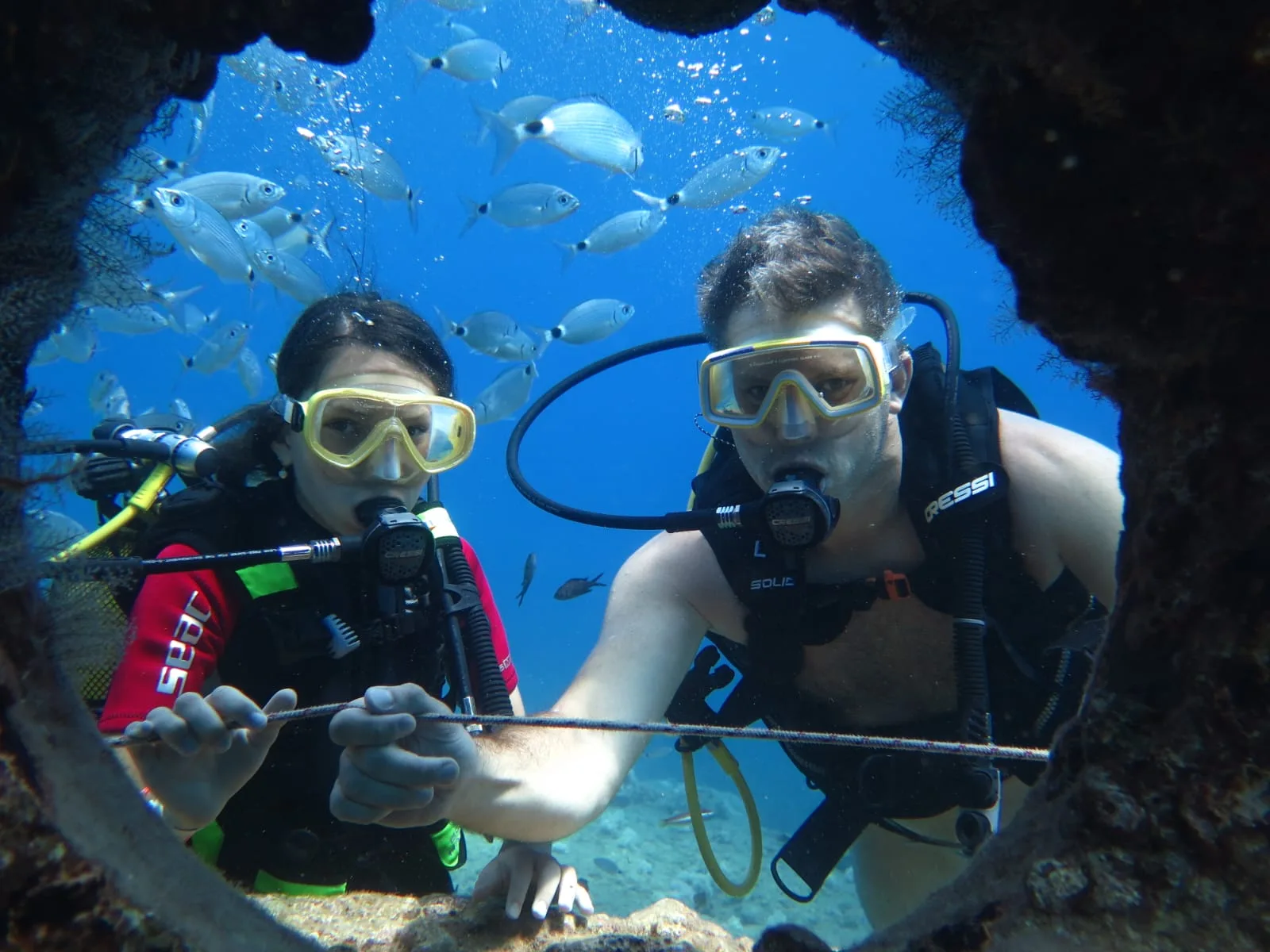
The day runs in a fixed order so nothing is rushed. A full safety briefing on board before anyone gets wet: how the regulator works, how to clear a mask, how to equalise your ears on the way down, the hand signals you will actually use. Then a shallow first dive where the instructor stays at your shoulder and fixes small problems as they appear — and small problems always appear on a first dive. Only once you are comfortable does the group go to the sculptures on the second dive of the Side Underwater Museum day.
No licence. No swimming test. No course to finish first.
What certified divers get on the same day
If you already hold a certification, you are not held to the beginner ceiling. Certified divers dive around 30 metres on standard certified dives and down to 60 metres on the deep sites when suitably qualified, so the museum is a shallow, relaxed dive for you rather than a limit. Bring your card and your logbook — we sign logbooks after the dives.
What that also means is that the sites you may have read about are yours and not the beginner's. The Paris II at 21–31 metres and the DO-28 aircraft wreck, a 1967 Dornier at 19.5–23.3 metres, sit squarely in certified range and are never a discovery dive. Those lie on other stretches of the coast: the wreck at Kemer, the aircraft off Antalya. If wrecks are what you came for, the Kemer diving day at €43 or the Antalya day at €50 is the better booking.
Couples and families often split the difference on one boat: one partner certified, the other trying diving for the first time. That works fine — same boat, same lunch, different profiles, and everyone surfaces with a story.
What actually can stop you diving
The licence is not the gate. Health is. Diving is not advisable while pregnant, or with severe asthma, heart or respiratory conditions. The standard diving medical questionnaire is what decides — you fill it in before the day, and anything it flags needs a doctor's sign-off before you get in the water. We do not diagnose and we do not overrule a doctor. If you are unsure, ask your GP before your holiday rather than at the harbour. A thermal inner suit (diving undergarment) or any extra neoprene layer is not included in the price and is available as an optional extra on request.
Age: try-dives start from about 10 years old, and younger children on board join as boat visitors instead. Non-divers in your party are welcome at a reduced rate — they get the boat, the coast and the lunch without ever putting a regulator in their mouth. Ask us for that rate when you book, since it depends on the trip.
Two more things worth planning around: no flying within 24 hours after diving, so do not book your dive day for the morning before your flight home, and reservations are free online with payment on the day in cash or card, free cancellation up to 24 hours before. If a CMAS course interests you rather than a one-off dive, ask — we run them on request. More detail sits on our general diving FAQ.