Cavern and cave are not the same word
Divers use one English word for two activities with completely different risk profiles, and the confusion is exactly why this question gets asked.
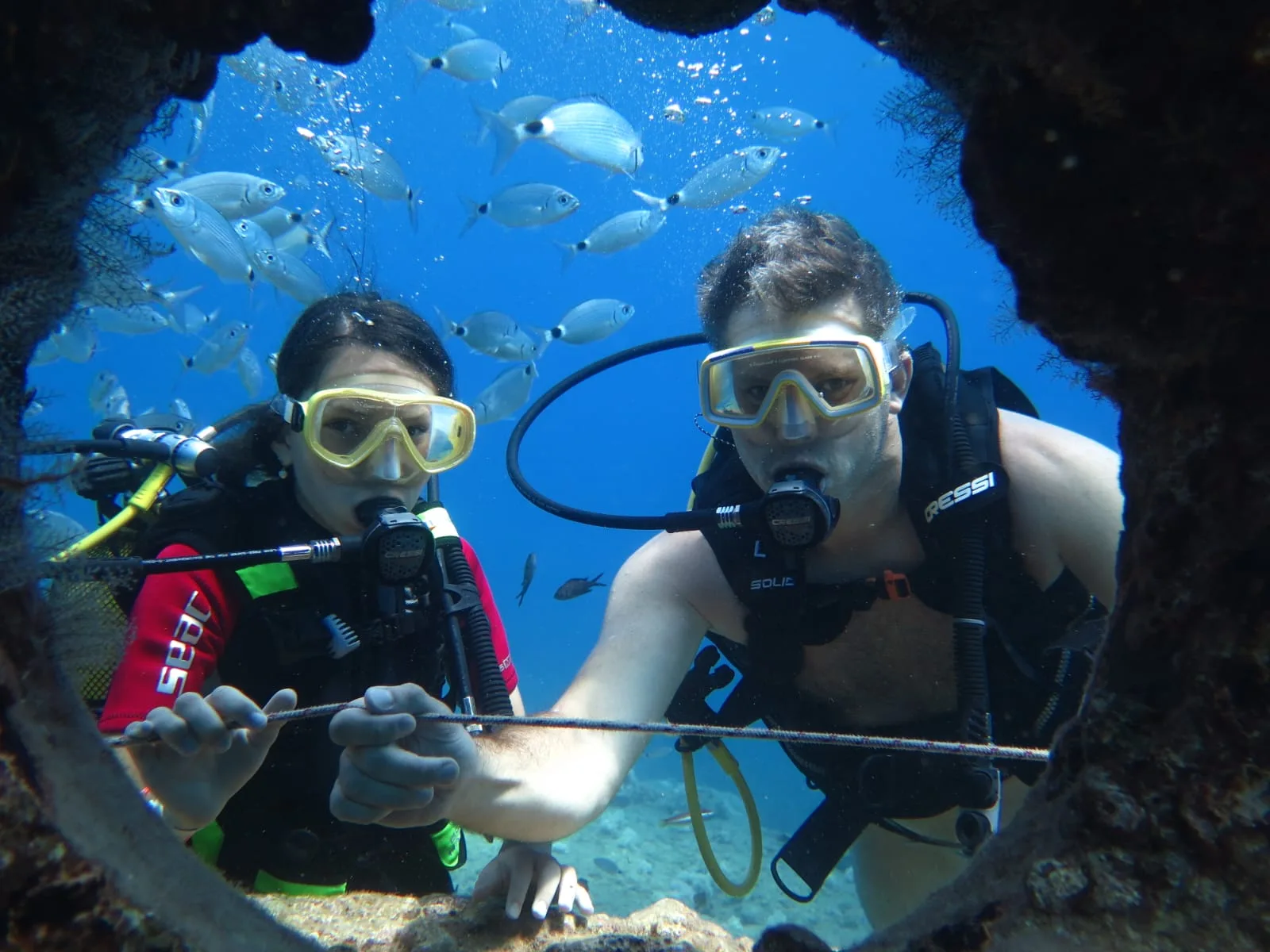
- Cavern. You are inside a rock formation but still inside daylight. The opening is visible, the way out is a straight swim towards the blue, and the passage is wide enough for a diver and an instructor side by side. Nothing about it requires equipment you do not already have on.
- Cave penetration. You go past the light zone into passages that turn, narrow and silt up. There is no direct ascent to the surface, so a problem must be solved horizontally, in the dark, on the gas you carry. It requires cave certification, a continuous guideline to the exit, redundant regulators and lights, and specific training in silt management and lost-line drills.
The whole risk of any overhead environment is one thing: the surface stops being an option. A cavern keeps that option a few metres away and in plain sight. A cave removes it. Treating them as the same activity is what gets people hurt, and it is the reason our briefings are explicit about which one you are doing.
What a guided diver actually does at Alanya
The Alanya diving day is €43 for eight hours, departing Alanya: two guided dives, all standard equipment, lunch on board, insurance and free two-way hotel transfer. The rocky coast there is full of cave mouths and rock arches, and they are the good kind — broad, short and open to the light.
If you have never dived, you are on the beginner tier: the morning dive at 5–8 metres, the second to about 13 metres maximum, with an instructor within arm's reach the entire time and no more than three or four divers per instructor. A swim-through on that tier means passing under an arch or through a wide opening with daylight ahead of you the whole way — seconds, not minutes, and always with the guide leading and the exit visible before you enter.
You are also allowed to say no. If a gap looks tighter than you want, your instructor takes you around the outside of the formation instead and nothing is lost. Certified divers work the same coast deeper — around 30 metres on standard dives — and can explore more of the Alanya cave formations where their training supports it.
Why we refuse some requests — and what to book instead
People do ask to be taken further in, and the answer is no. A discovery diver has had one briefing and has never had a mask flooded at depth by someone else's fin; putting that person past the light zone is not adventurous, it is negligent. We would rather lose the booking than hand you an experience you are not equipped to get out of. The same logic keeps discovery divers off the deep wrecks: the Paris II at 21–31 metres and the DO-28 aircraft at 19.5–23.3 metres sit inside the certified range and nowhere near beginner depth.
If overhead spaces make you uneasy at all, book somewhere else in our programme and enjoy the day instead of enduring it. The Kumköy day is €43 and six hours — our shortest and gentlest, all open water. The Side Underwater Museum at €45 puts around 110 sculptures at about 12 metres in completely open water with nothing above you but sky.
And if you want to move towards proper overhead training one day, CMAS courses are available with us on request — that is a training path, not a day trip, and we will talk it through honestly rather than sell it fast.