Why hands off, in plain terms
The moment a sculpture went into the sea it stopped being a statue and started being habitat. Within a season the surfaces carry a fine biological film — algae, tiny encrusting growth in the folds and on the shoulders — and that film is the bottom of the food chain that pulls fish onto an otherwise sandy seabed. A palm dragged across a shoulder wipes a patch of it away and leaves a bare mark that takes far longer to come back than it took you to make.
There is a selfish reason too. Your hands arrive at the site carrying sunscreen and skin oils, and they leave carrying whatever is growing on the stone. Encrusting growth can be sharp; a shallow scrape on a hand at 12 metres is a small thing on the day and an annoying thing for the rest of the holiday.
And there is the practical one: the museum is a shared site. If every diver on every boat touched one figure, the sculptures at the front of the field would be scrubbed clean and the ones at the back would look like the sea intended. We would rather they all looked the same in five years. That is the whole rule on the Side Underwater Museum day — look, hover, photograph, don't grip.
The skill that makes it easy: buoyancy and fin awareness
Beginners usually touch things for one reason — they are sinking and reach out to stop themselves. So the answer to touching is not willpower, it is buoyancy, and that is set up before you ever see a sculpture. On the first, shallow dive of the day the instructor gets your weights right and shows you how small a breath it takes to rise or settle. Once you can hold your depth with your lungs rather than your hands, the urge to grab disappears.
Fins matter as much as hands. The museum stands on sand, and a hard downward kick lifts a cloud that hangs in the water for minutes — ruining the photograph of whoever is behind you and hiding the next figure completely. The habit we teach is simple: stay slightly above the object rather than level with it, keep your fins higher than your head when you approach, and use short, slow kicks rather than big ones.
Certified divers know this; they still get the reminder in the briefing because a familiar diver in unfamiliar kit is the one who bumps things. If your buoyancy is rusty after a few years off, say so at the briefing rather than at 12 metres — it changes nothing about your day except how much the guide watches you.
What you can do down there
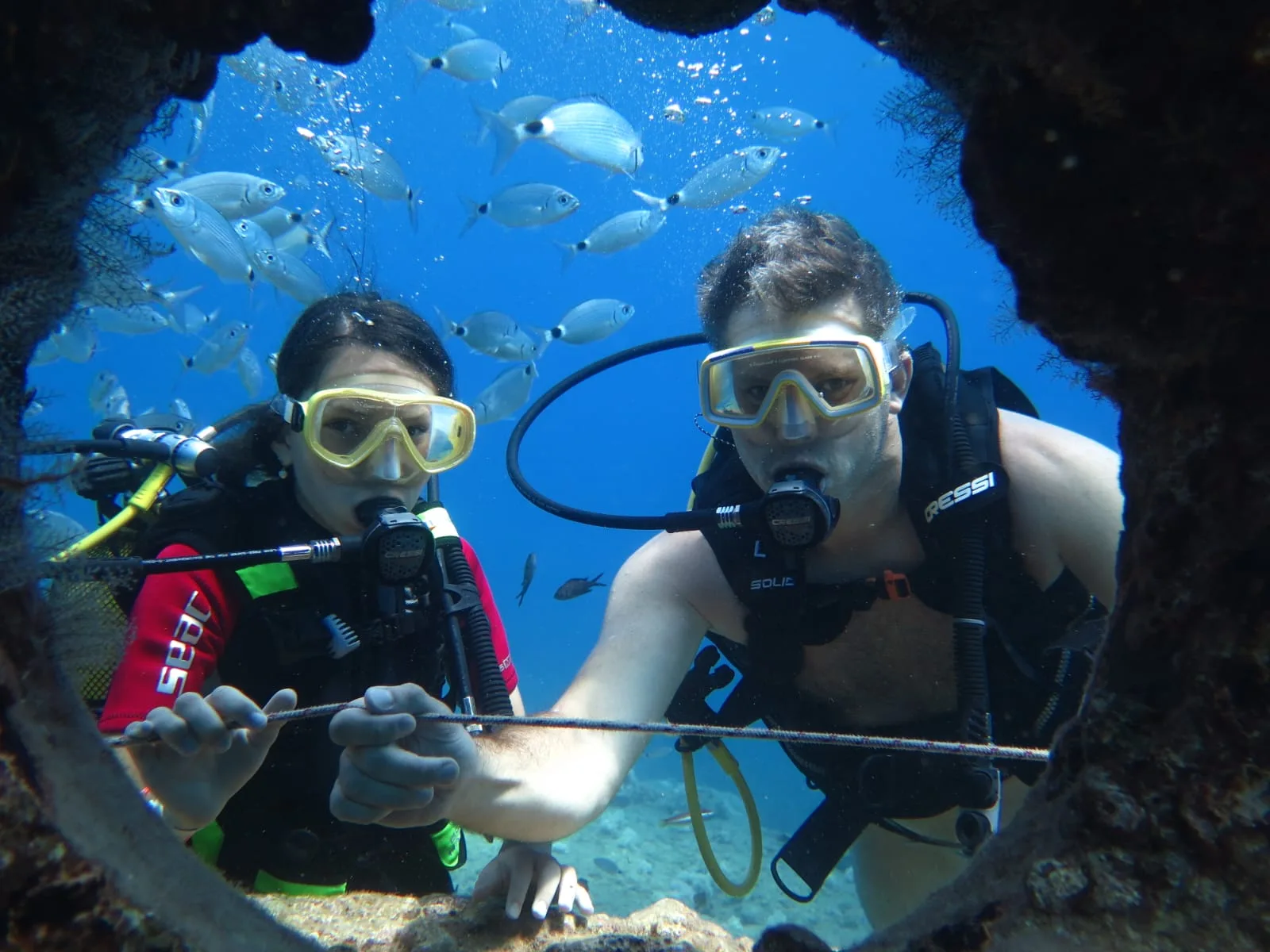
Plenty. You can come as close as your buoyancy allows — close enough to see the texture of the growth and the fish working the surfaces. You can hang above a figure and simply stay there; the sculptures are lit by daylight at this depth, which is why hovering is worth more than swimming laps of the site. You can shoot as much as you like, camera or action cam, and at around 12 metres there is usually enough natural light to get something worth keeping.
And you can put food in your hand, with the instructor holding it, and let the shoal come to you — the one moment on the day where the wildlife touches you instead. That is covered properly in can you really feed fish underwater.
The same etiquette carries to every other site we dive. On the Alanya day the amphora site holds ancient jars minutes from the harbour — those are archaeology, and touching them is not a matter of good manners but of leaving the seabed as we found it. The rule is easier to remember than it sounds: bring nothing down, take nothing up, leave no marks.